
Eletrificando a antropologia (Abram, Winthereik e Yarrow 2019)
Current thinking: an introduction
ELETRIFICAR A ANTROPOLOGIA para INVESTIGAR NOSSA VIDA ELÉTRICA
In short, the majority of people in Europe and America, at least, live in what we might term an ‘electromagnetic field’ to which they have become thoroughly habituated and whose scope is growing. (Abram et al. 2019:3-4)
While it is pervasive – though by no means universally available or accessible – electricity nonetheless has qualities that make it recede from view: it participates in daily routines familiar to the point they are taken for granted. (Abram et al. 2019:4)
Electrifying Anthropology aims to render electricity visible and interesting – a matter of concern to social sciences and the humanities. (Abram et al. 2019:4)
Electrifying Anthropology thus explores how electricity is not merely a resource for social life but also part and parcel of infrastructures in which people live. (Abram et al. 2019:4)
ELETRICIDADE DOMESTICADA-SOCIALIZADA
after a century of domestication, electricity is socialized and politically embedded in ways that now require sustained empirical attention, including how its histories and futures are performed (Abram et al. 2019:11)
ETNOGRAFIA
Descriptions of what electricity ‘is’ are presented as necessarily indissoluble from considerations of where, when, how, who and by what means it is made to be so. Our ethnographic focus extends to the various experts involved in the production of electric knowledge and infrastructure as much as to the ‘consumers’, who are more routinely the subject of social scientific attention. (Abram et al. 2019:12)
ELETRICIDADE NÃO FLUI?
Electricity does not flow; nor do electrons – this much is certainly known. When engineers talk about a flow of charge, on the other hand, they knowingly adopt the methods of physics and its use of models and metaphors that serve explanatory purpose without being direct representations of material phenomena. (Abram et al. 2019:13)
PERSPECTIVA ANTROPOLÓGICA
What might it mean to ‘know’ electricity anthropologically? (Abram et al. 2019:18)
DILEMAS DO ESTUDO DOS ProTeMAs
For example, if we adopt the language of engineers, can we then think critically about the social and ethical assumptions built into engineering approaches? If we refuse the language of engineers and scientists, how do we acknowledge or incorporate their learning? If we reproduce the language of energy policy, where is the space for subaltern voices in setting energy agendas? How, in other words, do we find ways to discuss electricity that encompass knowledge about its technical capacities without capitulating to the socio-scientific implications of technical debates? How, as Bakke puts it, can we take electricity seriously in its own right (see also Holbraad and Pedersen 2017)? (Abram et al. 2019:18)
ABRAM, Simone; WINTHEREIK, Brit R.; YARROW, Thomas. 2019. Current thinking: an introduction. In: Simone Abram; Brit R. Winthereik; Thomas Yarrow (eds.). Electrifying Anthropology: exploring electrical practices and infrastructures. London: Bloomsbury Academic, p.3-22.
Electricity is not a noun
A ELETRICIDADE É ELUSIVA
understanding electricity presents a number of serious conceptual problems. It is, simply put, very difficult to think. Weirdly, it is easier to make, work with and design for electricity than it is to know it. (Bakke 2019:26)
DILEMAS ELÉTRICOS
How does one count what is indivisible? How does one store instantaneity? How might one enslave the lethal? How does one extract profit from a force? We are now 140 years into the era of domesticated electricity, and none of these questions have been resolved in a satisfactory way. (Bakke 2019:26)
IMAGINAÇÃO
How electricity is understood and misunderstood, thus, matters a great deal to how future systems that make it and manage it are imagined, designed and built out. (Bakke 2019:26)
NOWHERENESS-IMMEDIACY
there is no electricity in a battery, just as there is no electricity in the reservoir behind a hydroelectric dam. This nowhereness (which might also be thought of as ‘immediacy’ or newness) causes electricity, as an abiding physical substance, to fade further from conceptual grasp. (Bakke 2019:30-1)
GENITIVO
This mode of building electrical systems that feel like the genitive (what difference really, between a pipeline and a power cable, between a tub of yogurt and a battery?) attempts to materialize an accord between a system of things and electromagnetism – which follows none of the same rules nor any of the same physical laws. One result is, as one might expect, that misunderstandings and weird preferences proliferate and are built out, legislated or funded. To my mind, this is part of the grid’s charm; it holds social desires, many of which are grounded in the wrong logic, in its form. These desires produce iterative breakdowns, as common-sensical wants for electricity systems and the functioning of these systems fail consistently to align. The grid is a misunderstanding machine; a machine that ‘works in practice, but not in theory’ (Alexandra von Meier, Personal Conversation, 2010). (Bakke 2019:32)
ELETRICIDADE É AGORA
What is electricity then, if not a noun? […] Electricity is now. (Bakke 2019:33)
EDISON e a ELETRICIDADE COMO GÁS
Understanding the importance of the temporal grounds for electricity networks requires a quick dip back into physics and twentieth-century solutions to the intractability of electric power. Because electricity doesn’t properly exist in space, a business aiming to make money of it must take one of two routes: it must sell not electricity but grids, or bits of grids (things), or it must manage temporal rather than spatial orders. This has been true from the start. Even Thomas Edison, who was quite savvy in turning the electric grid and its various components (lightbulbs, electric sockets, dynamos, wires, etc.) into marketable products, faded into ignominy in the mid-1890s precisely because he misunderstood the nature of electricity as a product. As he built the necessary infrastructure to make electricity a viable competitor on the home and office lighting market, what he saw was not its instantaneousness but a (mistaken) materiality akin to that of gas – a substance governed by the laws of fluid dynamics rather than those of electromagnetism. (Bakke 2019:33)
EDISON (eletricidade como coisa) x SAMUEL INSULL (eletricidade como tempo)
In other words, the immediacy of electricity – that it could be no more stored in Edison’s days than our own – meant that all the conventions of production and delivery well-known to markets, businessmen and capitalists in the late 1800s did not apply to the electricity business, and even Edison, who was both wily and brutally intelligent, didn’t grasp this in productizing his force. As a result, despite popular perception, Edison’s grid did not become the norm in North America; rather, the electricity system in use today is a mix of the alternating current grid developed by Nikola Tesla and brought to market by George Westinghouse in the late 1880s and a business model developed by Samuel Insull in Chicago in early 1900s. Without Insull, who was unique in his understanding of the exigencies of electricity as a lethal, un-storable, intensely immediate, non-liquid non-thing and who structured a business around these constraints, the United States would have had elite light (the system Edison’s grid was best suited to) in the form of private plants for wealthy customers, and industrial power for building and moving things, for much longer than it did. (Bakke 2019:34)
The history of electricity is littered with this precise battle between working with electricity’s obduracy or pretending it is something it is not, and then working with pretence. (Bakke 2019:38)
ELETRICIDADE NÃO É UMA COISA
Be all of this as it may, there remains the problem that even if we think electricity as if it is a thing – a delimited material object in the world – it doesn’t care. It continues to behave in most un-thing-like of ways. It is as immodestly indifferent to our metaphorizing modes of thought as it is to our laws or profit seeking. (Bakke 2019:38)
A RETÓRICA DO CONTEÚDO
Not just milk, but the tendency to manufacture containers (i.e. packaging) for many things that don’t need it in order that the things themselves become ‘contents’ would seem an additional interesting route of investigation into the ways in which grammatical
biases and the made-world interact, with landfills full of the genitive for proof. (Bakke 2019:39-40 nota 7)
BAKKE, Gretchen. 2019. Electricity is not a noun. In: Simone Abram; Brit R. Winthereik; Thomas Yarrow (eds.). Electrifying Anthropology: exploring electrical practices and infrastructures. London: Bloomsbury Academic, p.25-41.
At the edge of the network of power in Japan
VIDA ELÉTRICA
Historians tend to privilege the stories of early electricity adopters, but there was a substantial gap between the image of modern electrical life, circulated by electrification advocates and appliance manufacturers, and the reality of average consumers’ lives. A model room exhibited in a Transport and Electricity Exhibition (1928) was filled with various electrical appliances, such as electric lamps, heaters, dryers and an electric hair iron, and it was also equipped with seventeen electric outlets (Murase 2009, 52). Such electrical life was well beyond the means of the large majority of consumers. (Shin 2019:104)
SHIN, Hiroki. 2019. At the edge of the network of power in Japan, c. 1910s-1960s. In: Simone Abram; Brit R. Winthereik; Thomas Yarrow (eds.). Electrifying Anthropology: exploring electrical practices and infrastructures. London: Bloomsbury Academic, p.101-19.
Big grid
CIDADANIA/PERSPECTIVA ELÉTRICA
Electric citizenship is now synonymous with electricity consumption in industrialized societies running on big grids. As the next section explores in more detail, citizens, who have been transformed into consumers from an electric perspective, find their political concerns about the grid reduced to a matter of consumer rights. As this infrastructural history reveals, big data has been complicit in the disenfranchisement of electric citizenship. (Özden-Schilling 2019:168)
In 1882, when Thomas Edison, the disputed inventor of the incandescent light bulb and undisputed progenitor of the big grid, started charging the customers of his Pearl Street Station for electricity service rather than the equipment for its production (Rudolph and Ridley 1986), citizens were indefinitely transformed into passive consumers; from an electric perspective, ‘citizen’ and ‘consumer’ became interchangeable terms. (Özden-Schilling 2019:173)
ÖZDEN-SCHILLING, Canay. 2019. Big grid: the computing beast that preceded big data. In: Simone Abram; Brit R. Winthereik; Thomas Yarrow (eds.). Electrifying Anthropology: exploring electrical practices and infrastructures. London: Bloomsbury Academic, p.161-79.
Afterword
COMPLEXA, INDETERMINADA E INDISCRETA
electricity, as something that is so complex in its qualities and affordances, indeterminate in its meaning and indiscrete in its being (Pink 2019:201)
PINK, Sarah. 2019. Afterword: electricity as inspiration – towards indeterminate interventions. In: Simone Abram; Brit R. Winthereik; Thomas Yarrow (eds.). Electrifying Anthropology: exploring electrical practices and infrastructures. London: Bloomsbury Academic, p.201-8.
Relacionados:
 Transduções – Episódio [2]: WhatsApp, IA e o Futuro da Internet com Carol Parreiras e Analice Paron
 Matéria e sentido (Barad 2007)
 Big Other, capitalismo de vigilância e civilização de informação em Zuboff (2018 [2015])
 Liberar uma energia de desejo… (Guattari 1985 [1977])
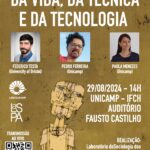 Sócio-filosofias da vida, da técnica e da tecnologia
 O Laboratório de Sociologia dos Processos de Associação (LaSPA) é sediado no Instituto de Filosofia e Ciências Humanas (