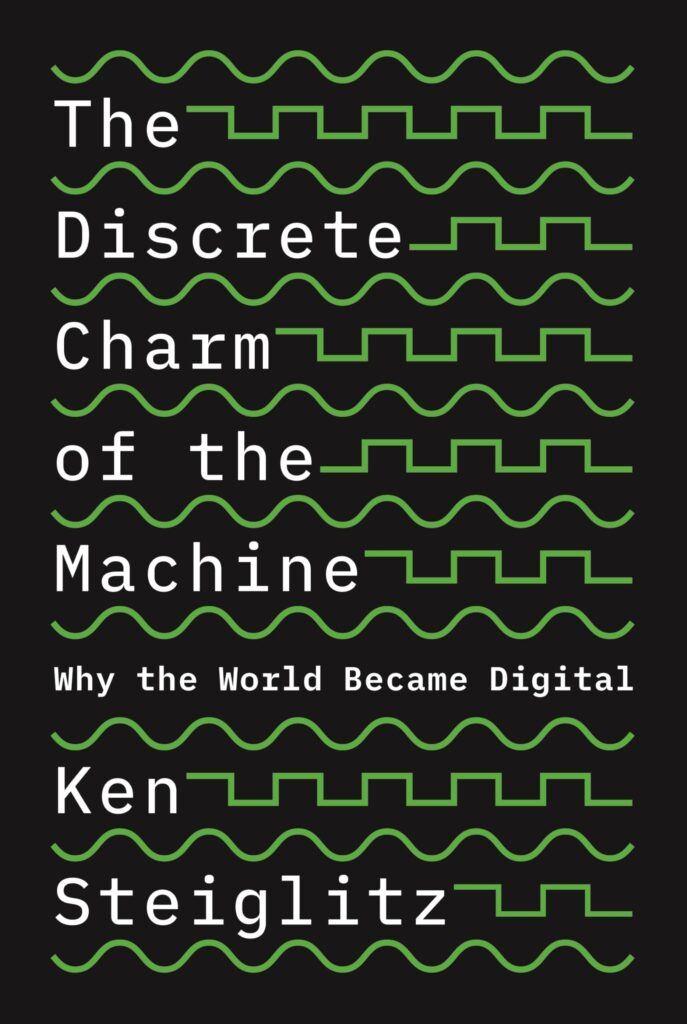
Condutância assimétrica em Steiglitz (2019)
3.3 Directivity of Control […] I’ve referred above, without explanation, to logical signals propagating in one direction, from stage to stage, in a digital computer. This brings us to the second critical property that signal-carrying elements must have for a computer to work: signals must be unidirectional. Controlling elements must control controlled elements, and never the reverse. […] According to this picture, we can envision a digital computer as a network of interconnected elements, called gates, each of which has controlling logical signals (each TRUE or FALSE) called inputs, that determine controlled logical signals called outputs. This is not to say that control cannot sometimes loop back on itself. It may very well happen that gate A controls gate B, which controls gate C, which in turn controls gate A. But each gate determines its output from its inputs, and the outputs of each gate can control only the inputs of others. (Steiglitz 2019:24)
STEIGLITZ, Ken. 2019. The discrete charm of the machine: why the world became digital. Princeton University Press.



 O Laboratório de Sociologia dos Processos de Associação (LaSPA) é sediado no Instituto de Filosofia e Ciências Humanas (